Full circle: why I joined Minster Law

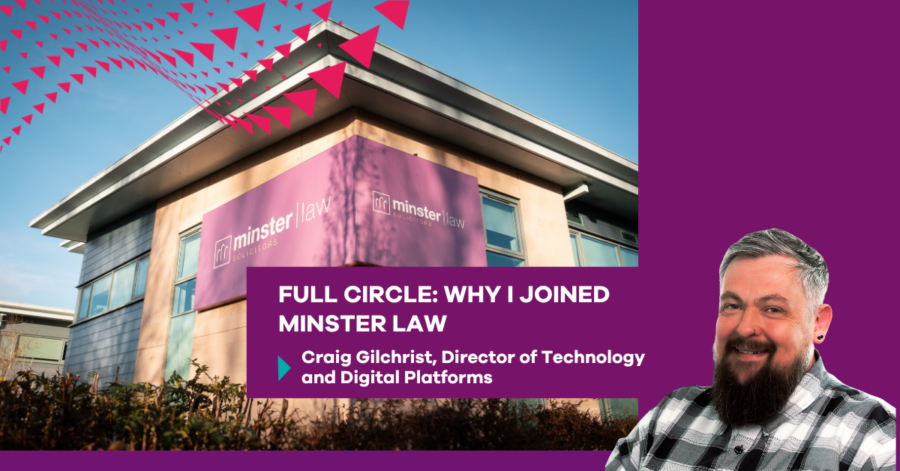
When I sat down to write this, I realised it’s the first time in eighteen years I’ve written one of these pieces as anything other than the founder of my own business. That’s a strange feeling, and a good one.
In November 2025 I made a decision I genuinely didn’t see coming a year earlier. After almost two decades of working only for myself, I joined Minster Law as Head of Digital Product Delivery on the first of December 2025. Six months later, in May 2026, I am stepping into a new role as Director of Technology and Digital Platforms, joining the Executive Committee. Here’s how I got here, and why I’m so excited about what comes next.
From 2008 to 2022 I built an incredible digital Agency with my good friend Andy. We started with nothing and grew it to seven figures in annual turnover, working with brands across finance, retail, sports and entertainment, agriculture and legal. We ran design sprints, built secure platforms, shaped strategy and shipped digital products that were used by millions of people.
It was also where I started working with AI, long before it became fashionable. As early as 2009 we were building image analysis pipelines for a global agricultural client to detect crop deficiencies from photographs. Years later we built a conversational AI assistant for one of the UK’s biggest retailers, alongside other machine learning and natural language projects for clients who wanted to do something different. Most of these projects never made the press releases. They just quietly worked.
Along the way I was asked to write a technology book by a publisher and asked to give a TEDx talk. Both came out of work we’d already done rather than work I was looking to promote, which is the way I’ve always preferred it.
What I learned in those fourteen years wasn’t really about technology, the agency, the writing, the talking, the building. It was about people, and what’s possible when you give them the right tools. The clients we did our best work with were the ones who trusted us with the messy bits, who let us in early, who cared as much about the experience their customers were going to have as we did. The technology was always the easy part. Getting the conversation right was the hard part, and the part that mattered most.
I left the agency after Covid for a break and to do some new things. I’d planned on taking the best part of a year off. I lasted three months.
What pulled me back was the next wave of AI. In 2022 I was asked by an American friend of mine to build a pioneering tool that used AI pipelines to generate audio described versions of video for blind and partially sighted audiences, alongside a handful of other video AI projects. After more than a decade of working with the technology in its earlier forms, this felt different. The pace had changed. The capabilities had changed. And it was clear we were entering a moment that would reshape entire industries.
From 2023 to 2025 I founded and built a VR streaming platform that today delivers nearly a full year’s worth of live streamed content every single day of the week. We went through the funding rounds, we shipped, we grew a brilliant team. By late 2025 that company was running well, the team didn’t need me in the way they had two years earlier, and I started asking myself what I wanted to do next.
For the first time in eighteen years, I considered the idea of going to work for someone else.
I went back through my old moleskines from the agency days, looking for clues. What I was really doing was trying to remember which clients had genuinely moved me. Which ones I’d left meetings energised by. Which ones I’d talk about in the pub.
I came across notes from a design sprint we’d run for Minster Law back in 2017. What struck me wasn’t what was in the notes. It was what wasn’t. The personal injury sector was preparing for significant change as a result of the Civil Liability Act (2017), and Minster like everyone else was trying to work through how best to prepare. None of that was in the notes.
Every conversation, every workshop, every scribbled idea was about the client. About the experience. About doing right by clients at the worst moment of their lives. The character of Minster Law came through every page, even years later.
Around the same time that I was reading my old notes, I saw a post from Shirley Woolham which delivered the same message in a different way. It was reflective, generous, and entirely focused on looking after colleagues through difficult moments. I sent her a message and asked if she’d grab a coffee.
That coffee turned into meetings with the rest of the executive team. By the end of those conversations, I knew. The people are extraordinary. The ambition is real. And the opportunity in front of this business, as a digitally led firm in a sector that’s about to be reshaped by AI, is one of the most exciting I’ve ever seen.
I joined as Head of Digital Product Delivery on the first of December. Six months later I am stepping into a new role as Director of Technology and Digital Platforms, joining the Executive Committee. That decision, the firm’s decision, is the one that’s prompted me to write this. It feels like the moment to mark.
Here’s what I believe.
Personal injury law is at an inflection point. The combination of modern data platforms, AI, and proper product thinking is going to redefine what a law firm can do for the people it serves. Not by replacing the lawyers, the case handlers, the human relationships that sit at the heart of this work, but by giving those people better tools, faster information, and more time to focus on the parts of the job that need a human.
None of that happens without the right team behind it. One of the first things I’m focused on is getting the most out of the incredible people already in IT here, who have built and held together a complex estate through some genuinely demanding years.
There’s deep expertise in this team and my job is to give it the space and direction to do its best work. Alongside that we’ll be bringing in fresh talent in the areas where we need to grow, and aligning the whole function around the Product Operating Model the change team has been building. That alignment matters. It’s how technology stops being a service that gets asked for things and starts being a partner that helps shape what the business does next.
A couple of principles shape how I think about this. The first is buy commodity, build advantage. AI models and infrastructure are commoditising fast, and that’s a good thing because it means we don’t have to spend our energy reinventing them. What nobody else has is our data and our people, so that’s where we focus. The second is that technology should remove friction and emphasise humanity. The best uses of AI in a law firm aren’t the ones that automate the human moments, they’re the ones that protect them, by handling everything else around them faster and better.
We’re building the foundations that let our people do their best work. Technology that puts the right information in front of the right person at the right moment. Live insights and the groundwork for genuinely intelligent capability that understands how we work and helps us do it better.
The point of all of this isn’t the technology. The point is the people. Minster Law has always been a firm built on the care and judgement of the people inside it, and the most exciting thing about this moment is that these building blocks give those people more time, better information, and genuinely useful intelligence at their fingertips. Those building blocks provide delightful outcomes for a Minster Law client, a Minster Law colleague or a Minster Law partner. That’s the bit I came here for.
Eighteen years of running my own businesses and working with some of the most incredible companies taught me a lot about technology. It taught me even more about the kind of organisations that actually deliver on their promises. The ones that do are the ones that take their people seriously, that take their customers seriously, and that don’t pretend the difficult bits are easy.
That’s what I found at Minster. It’s why I’m here. And it’s why I’m more excited about the next few years than I’ve been about anything in a long time.