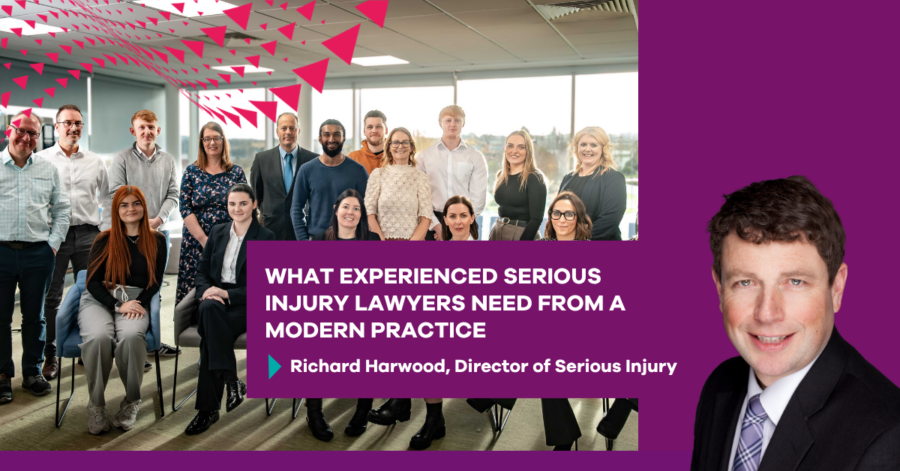
What experienced serious injury lawyers need from a modern practice

After more than 30 years working exclusively for claimants in personal injury, I have become increasingly convinced that the quality of serious injury work is shaped by more than legal expertise alone. It is also shaped by the environment in which that expertise is applied.
The best serious injury lawyers need more than technical ability. They need access to the right work, the time and support to handle it properly, and the freedom to make sound decisions in the best interests of the client over the long term.
That’s really important because serious injury practice has never been just about progressing a claim. It is about understanding the wider human impact of life-changing injury, helping clients and families navigate complex futures, and building the right legal and rehabilitative strategy around them. When the environment is right, lawyers are better able to do that work properly. When it is not, quality can be constrained by pressures that have little to do with the client’s needs.
In my experience, that is one of the reasons experienced serious injury lawyers become increasingly selective about where they practise. They are not simply looking for a new role. They are looking for the conditions that allow them to do their best work.
At Minster Law, we have built our Serious Injury team around those conditions.
The work is genuinely specialist
One of the defining features of our team is the breadth and depth of the work itself. Through long-standing relationships in the motor sector, Minster Law receives a substantial volume of serious injury cases, creating a caseload mix that is unusually rich in both value and injury type. That gives our lawyers exposure to a wide range of complex claims, from serious orthopaedic injuries and amputations to brain injury, chronic pain and spinal cord cases.
Our structure reflects that complexity. Lawyers build expertise progressively through clearly defined case value bands, with opportunities to deepen their experience in particular injury areas over time. For some, that means developing across a broad serious injury caseload. For others, it means building real depth in a more focused specialism.
That matters because specialist capability is not built through title alone. It is built through repeated exposure to complex issues, high-quality supervision and the opportunity to develop judgement over time.
Lawyers need room to exercise judgement
Serious injury work demands careful thinking, sound tactical judgement and a willingness to pursue the right outcome rather than the quickest one. That becomes much harder in environments where internal economics or billing pressures distort decision-making.
At Minster, our Serious Injury lawyers do not work to billing targets. That is a deliberate choice. It gives lawyers greater freedom to focus on what the case and the client actually require, whether that is exploring rehabilitation in more depth, understanding future care and accommodation needs, considering settlement structure carefully or taking a firmer position where the client’s interests demand it.
That does not mean a lack of discipline or accountability. Quite the opposite. It means building a model in which professional judgement sits where it should: at the centre of case strategy.
For experienced lawyers, that can be a significant difference. It allows them to practise in a way that is both more thoughtful and more aligned to why many came into serious injury work in the first place.
Quality work needs proper capacity and support
Another important factor is capacity. In serious injury, quality can suffer when case numbers are too high or when lawyers spend too much of their time on administrative work..
Our Serious Injury teams are intentionally small, with each lawyer working as part of a close team structure and handling a limited number of cases. That creates more time and space to explore issues properly, maintain stronger client relationships and progress claims with the level of care they require.
We also place importance on the support model around the lawyer. Operational management and wider team support are there to support lawyers with administrative work, so more time can be spent where their expertise adds most value: on legal strategy, client care and outcome delivery.
That combination of manageable complexity, focused support and lower-volume caseloads is one of the reasons our lawyers are able to engage with cases in depth rather than simply keep them moving.
Expertise should be shared, not siloed
No serious injury lawyer, however experienced, benefits from working in isolation. The best teams are those where expertise is shared openly, technical discussion is part of the culture, and lawyers are encouraged to bring their own style while still learning from those around them.
That is something we place real value on. Our lawyers work in collaborative teams where ideas, experience and tactical thinking are shared freely. More complex and higher-value matters benefit from close peer input, and technical oversight is embedded into how the department operates.
That creates a more supportive environment, but it also raises standards. Good serious injury work is rarely the product of one person acting alone. It is more often the result of strong individual judgement strengthened by access to collective expertise.
For lawyers looking to keep developing, that matters. It allows them to deepen their own specialism while contributing to a broader culture of excellence across the team.
A different kind of serious injury environment
Every serious injury practice will say it cares about clients. The more revealing question is whether the operating model genuinely gives lawyers the conditions to act on that commitment.
In our experience, experienced lawyers increasingly look beyond the headline offer. They look at the quality of the work, the structure of the team, the degree of autonomy, the seriousness of technical support and whether the wider model is built around client outcomes or internal pressures.
At Minster Law, we have worked hard to create an environment where lawyers can focus on complex, life-changing cases with the time, support and trust needed to handle them well. For lawyers who want to deepen their serious injury expertise and do that work in a way that is thoughtful, collaborative and genuinely client-focused, that is what makes the difference.
If you’re passionate about helping seriously injured people rebuild their lives – and you want to be part of a business that’s ambitious, growing and genuinely people‑first – there’s a place for you at Minster Law.
Whether you’re based in London, elsewhere in the UK, or working remotely, we offer a flexible, modern working environment where talented legal professionals can thrive.