Pete’s Story: From Fire Commander to Life-Changing Injury, and a New Purpose Beyond Adversity

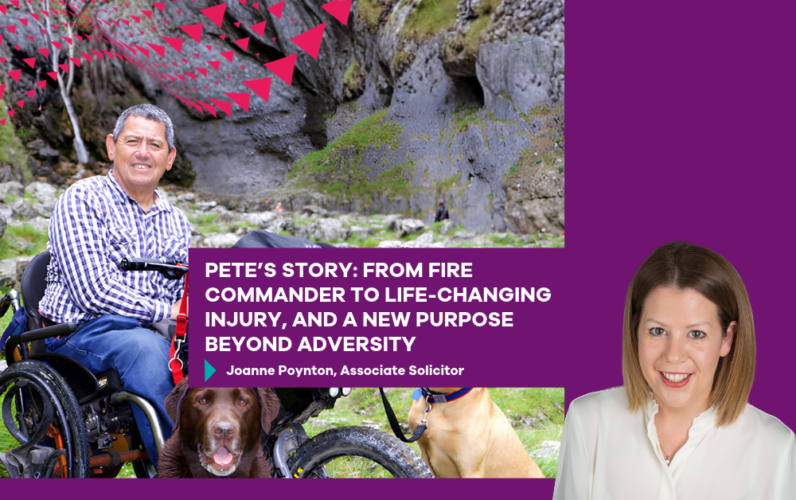
I first met Pete around 9 years ago when I became involved with Spinal Unit Recreation Fund (S.U.R.F), which is a spinal injury charity which operates out of the spinal unit at Pinderfields Hospital, Wakefield. It soon became clear to me that Pete is the epitome of resilience. Pete isn’t someone we have represented, but his story reflects so much of what our clients go through. The clients I am instructed to represent have all sustained catastrophic injuries. They must navigate what has happened to them and deal with the effects their injuries have had on their family. Many clients suffer from post-traumatic stress and lack motivation and in some cases hope for the future. I asked if Pete would speak to me and share his story in the hope that it would encourage others and show there is hope after a spinal cord injury (SCI).

For more than twenty-five years, Pete dedicated his life to helping others. As a District Commander with West Yorkshire Fire and Rescue Service, he attended major incidents, serious road traffic collisions, fires, and emergencies across the Bradford and West Yorkshire area. He was physically fit, which he says helped him survive his injuries, fiercely competitive, and lived an active life filled with adventure, travel and outdoor pursuits.
Pete is married to Debs and has 2 children. He describes having an amazing life which he lived to the full before his accident.
In 2014, while mountain biking with colleagues near Bainbridge in North Yorkshire, Pete was travelling along a country lane. Competitive by nature and enjoying the ride, he entered a bend unaware that a car was approaching the corner in the opposite direction, a collision occurred. The collision was catastrophic.
Pete’s injuries were extensive. Every rib was fractured. He suffered a double pneumothorax, multiple fractures including his shoulder and leg, a head injury and most significantly, a complete T6 spinal cord injury that would leave him paralysed from the chest down.
Emergency services raced to save his life. During the rescue Pete’s heart stopped multiple times, requiring repeated resuscitation. An air ambulance transported him to James Cook University Hospital, a journey Pete firmly believes saved his life.
Pete was placed into an induced coma for a prolonged period and battled severe trauma and repeated infections. When he finally emerged from intensive care, he faced the reality that his life would never be the same. Much of this period is a blur.
Pete was eventually transferred to the spinal injuries unit at Pinderfields Hospital. Pete could only move one finger when he first arrived at the Unit. Pete entered the next stage of his journey: rehabilitation. Everyday tasks that had once been automatic now had to be relearned from the beginning. Pete endured months of rehabilitation. He recalls seeing himself in a wheelchair for the first time was an emotionally devastating moment.
It was during this period that he met Wayne Cunningham and Peter Hanley who ran a charity called S.U.R.F. The charity was founded by former patients with lived experience.

One of the most significant influences in Pete’s recovery was the support he received from S.U.R.F, a peer-support organisation made up of people living with spinal cord injuries themselves. During his time at Pinderfields, members of S.U.R.F visited regularly, often coming to see him twice a week. Unlike doctors, physiotherapists and nurses, these were people who truly understood the reality of life after spinal cord injury because they were living it every day. He could talk about his pain, his bowel and bladder management and get support from people dealing with exactly the same issues that he was.
For Pete, that connection was invaluable.
The members of S.U.R.F did not offer false hope or try to minimise the enormity of what had happened. Instead, they spoke honestly about the challenges ahead while demonstrating that a meaningful life was still possible. Their presence gave Pete something he desperately needed during those early months of rehabilitation: hope.
One conversation in particular left a lasting impression. As Pete lay in bed repeatedly asking himself, ‘why has this happened to me’, one of the peer supporters offered a different perspective: why shouldn’t it happen to you? Over time Pete reflected upon this discussion and realised the truth behind it. Accepting that reality became a crucial step towards recovery.
Looking back, Pete believes peer support remains one of the most undervalued elements of rehabilitation. The support he received through S.U.R.F was so influential that he later became involved in the charity himself, using his own experiences to help others facing the same uncertain future. Pete says that S.U.R.F is different from other spinal charities as they take patients out into the community – this could be to the races, bowling, a day to the seaside, out for a meal – all invaluable activities to reintegrate people back into the community before being discharged from hospital.
While paralysis is often the most visible consequence of spinal cord injury, Pete explains that chronic pain is one of the most debilitating aspects of his condition.
In the years following his accident, neuropathic pain became a constant presence. Like many people with spinal cord injuries, he was prescribed strong neuropathic pain medication. Whilst these drugs helped manage some symptoms, Pete describes feeling as though he was living in a fog. The medication dulled his concentration, reduced his motivation and affected his sense of self.
Over time, Pete has found a way of managing his pain that works for him, and today he relies on far less medication. Yet the pain remains a daily challenge.
Before the accident, Pete loved travelling, exploring and being outdoors. As friends gradually returned to their own lives and continued the activities he once enjoyed, he was forced to watch from the sidelines. Despite their support, he experienced isolation and depression.
Pete says it wasn’t until 4 years post-accident that he finally came to terms with his SCI. He describes periods of significant depression and feeling that he was a burden on those he loved. He describes hearing certain noises now which still trigger memories of what he has been through.
Pete discovered that remaining mentally engaged and physically active provided one of the most effective ways of managing his symptoms. If he spends too much time inactive, both his physical discomfort and mental wellbeing deteriorate.
Photography became central to this approach. Researching wildlife, planning photographs, travelling to locations and waiting patiently for the perfect shot all require intense concentration. When immersed in the process, Pete finds that his focus shifts away from pain.
This philosophy now underpins much of the advice he gives to newly injured people. Rather than focusing on what has been lost, he encourages people to identify what remains possible, find a purpose and build a life around meaningful activities.
Through S.U.R.F, photography, volunteering and advocacy work, Pete discovered a new purpose. Combined with time outdoors, photography became both a passion and a form of therapy. He supports others through spinal injury charities, helps individuals navigate practical challenges and continues to champion accessibility.
His passion eventually led to the creation of Accessible Nature, a project designed to help disabled people access outdoor spaces. Through detailed guides and practical accessibility information, Pete has helped thousands reconnect with nature. Pete has appeared on the local news, ‘The One Show’ and ‘Winterwatch’.
For Pete, recovery was never about returning to the person he was before the accident. Instead, it became about building a new life founded on acceptance, resilience and purpose. His story demonstrates that while spinal cord injury changes life forever, it does not eliminate the possibility of achievement, fulfilment or happiness.
His message is simple: ‘focus on what remains, not what has been lost’. The accident changed his life forever, but it did not take away his resilience, determination or ability to make a difference.
Pete is an exceptional photographer, and he has kindly given permission for me to share some of his photographs (www.accessiblenatureuk.com).


Joanne Poynton is a Senior Associate Solicitor at Minster Law who specialises in spinal cord injury claims. For the last 9 years she has worked closely with S.U.R.F, a charity based out of the spinal unit at Pinderfields Hospital in Wakefield, close to Minster Law’s head office. Inspired by the remarkable resilience of the people she meets through her work, Joanne wanted to share Pete’s story to offer hope and encouragement to clients who are often facing some of the most challenging periods in their lives. Through Pete’s experience, she hopes to demonstrate that although a spinal cord injury can be life-changing, it doesn’t define a person’s future or limit their ability to live a fulfilling and meaningful life.
Since 2017, Joanne and her team at Minster Law have helped to raise thousands of pounds to support S.U.R.F, through events, fundraising and colleagues volunteering, recognising the invaluable role the charity plays in helping individuals with spinal cord injuries rebuild their confidence, independence and sense of purpose. Pete’s story is a powerful example of the impact that support, determination and resilience can have on the recovery journey.